
Digital Fast Food
AI makes it easy to skip the friction of understanding. I am starting to wonder whether that friction is part of thinking itself.

I am a millennial. I grew up before everything became instant. And I genuinely liked difficult things. Long articles, long conversations, problems that did not have a quick solution. I could spend hours absorbed in something simply because I wanted to understand how it worked. At least, that is how I remember myself.
Recently, I started noticing something about myself that I really do not like. Give me a long answer now, and my first reaction is often irritation. Not because the answer is bad. Sometimes it is exactly the answer I asked for. It contains context, arguments, caveats, and maybe even the details that are actually necessary to make a considered decision. But I look at the text and think: just tell me the answer. Yes or no. Will it work or not? What should I choose? Give me the conclusion so I can make the decision and move on.
And that “move on” is what worries me. Move on to where?
When I first started using AI seriously, I loved long answers. I asked questions, read explanations, argued, and asked follow-ups. It felt like an endless space for curiosity. Then AI became part of my workflow. At the same time, there were more projects, decisions, and tasks. There is always something next. Somewhere along the way, I started wanting not to understand, but to know enough to continue.
It feels incredibly productive. And often it is. Time is the only resource you cannot replenish. Trying to save it makes sense. Why spend an hour if you can do something in three minutes? Until you notice that you are not only optimizing the boring parts, but the process of thinking itself.

We know how fast food works. It removes friction. You do not have to cook, wait, or think. Everything is fast, predictable, and rewarded quickly. One meal is not a problem. The problem begins when it becomes your diet.
The same thing seems to be happening with information. Shorts, headlines, TL;DRs, summaries. Each one is not evil on its own. Neither is AI. But together they create an environment in which resistance starts to feel like a defect. A fifteen-minute video is too long, a detailed text is evasive, and a difficult question is irritating because it refuses to become simple quickly enough.

The internet had been moving in this direction for a long time. It is easier for algorithms to sell emotion than nuance. This is good, that is bad. This person is right, that person is an idiot. Get angry, feel inspired, be afraid, keep scrolling.
Real life does not agree to those terms. Important decisions are rarely unambiguous. Sometimes both options are bad. Sometimes both are good. And when your information diet constantly rewards instant answers, uncertainty starts to feel infuriating. Maybe that is why conversations become aggressive so quickly: complexity starts to irritate us.
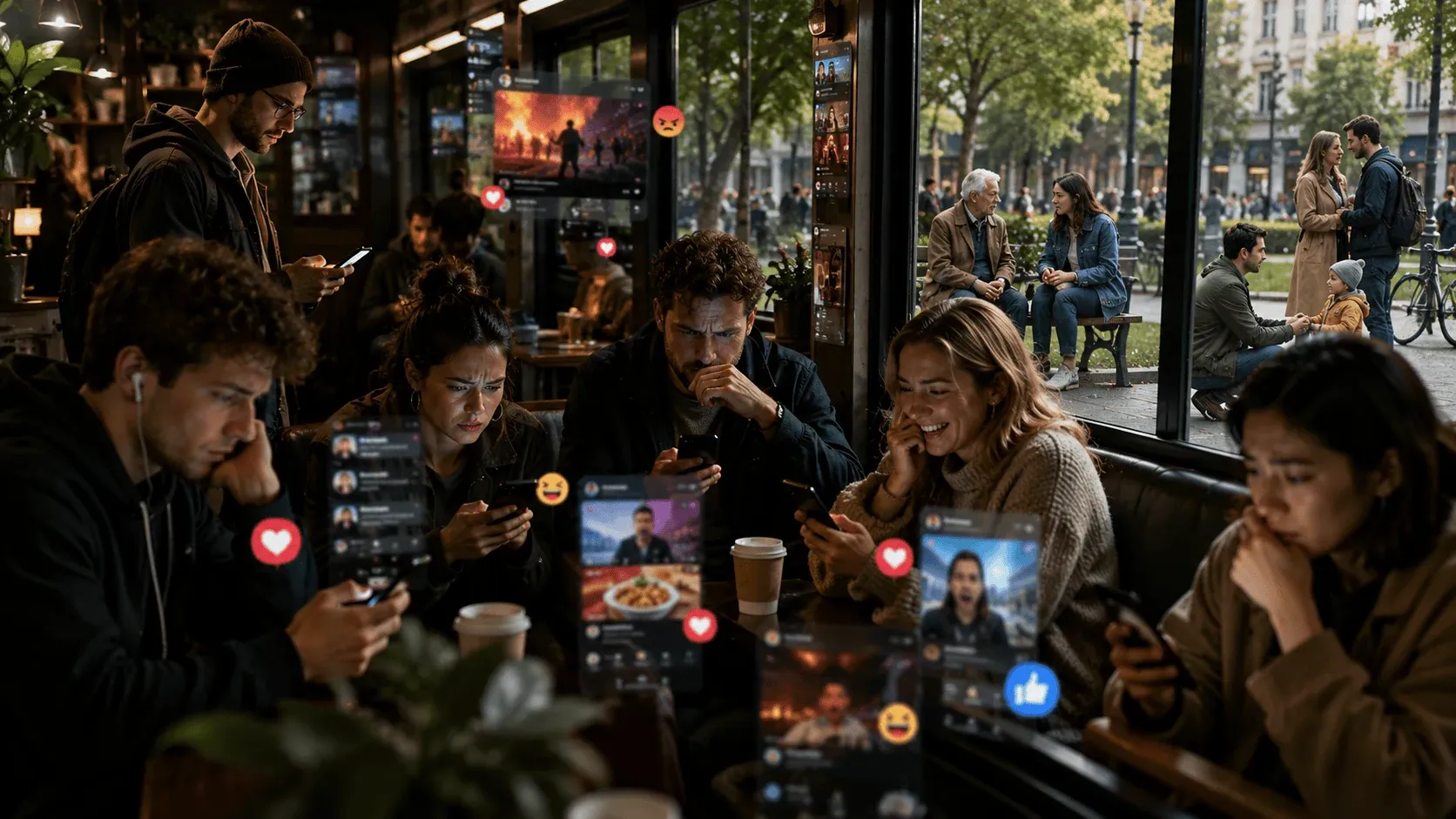
AI did not invent this problem. It has simply taken it to the extreme. Do not want to read? Summarize it. Do not understand the argument? Simplify it. Do not know what to think? Give me the pros and cons. These are fantastic capabilities. I use them all the time.
We talk a lot about AI slop: meaningless texts, interchangeable posts, endless content. But underneath that is something more important. The cost of producing information is approaching zero. The cost of human attention is not. We can produce more text, images, and opinions than anyone could physically consume. And the solution to information overload becomes yet another tool that produces information. Somewhere inside that loop, I am sitting and trying to save five minutes.
There are states I increasingly try to escape: sitting with not understanding, rereading a paragraph, not knowing which option is better, formulating an argument myself. It is inefficient. It is uncomfortable. AI is getting better and better at helping me avoid all of it.
But I am beginning to wonder: was that friction part of the process of understanding? Maybe understanding is not only the moment when the answer arrives, but all the time while it has not arrived yet.
Maybe that is why I started writing this blog in the first place. I do not want everything I do to turn into a photo and two lines saying, “Here is what I did.” A long text makes me slow down, reconstruct what actually happened, and figure out what I think about it. In a way, it is one of the few places where I consciously do not optimize for speed.

I have written before about how easy it is to build a life you did not quite choose yourself. This strangely rhymes with that. Only now the scale is different. Not decades, but a Tuesday afternoon. One small decision to skip ahead, and suddenly the day has taken shape in a direction you did not intend.
I am not giving up on AI, and I am not pretending it is not here. But I still do not have a clear system for avoiding a complete slide into “faster and further” mode. I am trying to understand where the boundary is. Which friction is wasted time, and which friction is thinking itself? Which answer can be obtained in thirty seconds, and which question deserves an entire evening?
Maybe digital fast food does not make us stupid. Maybe the subtler danger is that thinking starts to feel optional. And if something remains optional for long enough, at some point we may simply forget why we ever did it in the first place.