
Hobbies Without a Roadmap
Sometimes the best way to stop thinking about work is to find something else worth thinking about. The hard part, at least for an engineer, is not turning that something into another project.

I keep noticing a strange thing. The workday ends, but work somehow doesn't. The laptop is closed. Slack has stopped blinking. You're home, having dinner, talking to your family, doing whatever people do after work. Formally, work has been left somewhere else. And then, completely out of nowhere, you catch yourself thinking about some problem again.
Why did we build it that way? Maybe another approach would have been better? Or the solution to something you spent hours on during the day suddenly appears in your head in the evening. It gets especially funny when, in the middle of a completely normal family conversation, you suddenly start explaining some work problem. Sometimes it takes a couple of minutes before you even notice.
You're home, but some part of you is still at work. I guess that's one of the peculiarities of professions where the main working tool is your head. You can't leave it at the office next to the laptop. And it doesn't necessarily have anything to do with overtime. You can honestly work your eight hours, close the computer on time, and not open it again until the next morning. But the brain doesn't know how to shut down on schedule.
An unfinished problem keeps running somewhere in the background. An architectural decision comes back to you in the shower. The bug you couldn't find during the day suddenly makes sense just before you fall asleep. If nothing competes with that, work slowly stops being something you do for eight hours a day. It becomes background noise. That's where hobbies turned out to be unexpectedly important for me.
Although even the word hobby bothers me a little here. It sounds like you're supposed to choose one proper activity and stick with it for twenty years. That's not how it works for me. Sometimes it's cycling. Sometimes something in the garden. Sometimes wood. Sometimes a 3D printer. And sometimes it's something completely new that I knew absolutely nothing about a week earlier.
A few years ago, for example, I started building large RC cars. Not buying finished models. I found a creator whose designs I really liked. I buy the model from him, print the parts, and slowly build the car almost from scratch. I'm on my third or fourth one now. And the interesting part is that the finished car is almost not the point.
I like the journey from an image to a working thing. At first, it's just a pile of parts. Then there is a frame, suspension, transmission, wheels, bodywork. Something doesn't fit, something has to be redone, you cut the windows, adjust them, glue them in, install the motor, connect everything. And at some point, the whole thing actually starts moving. I genuinely enjoy every single bolt I tighten.
I think a big part of that comes from the fact that, when I started, I knew absolutely nothing about it. There was nothing to optimize. There was no version two.
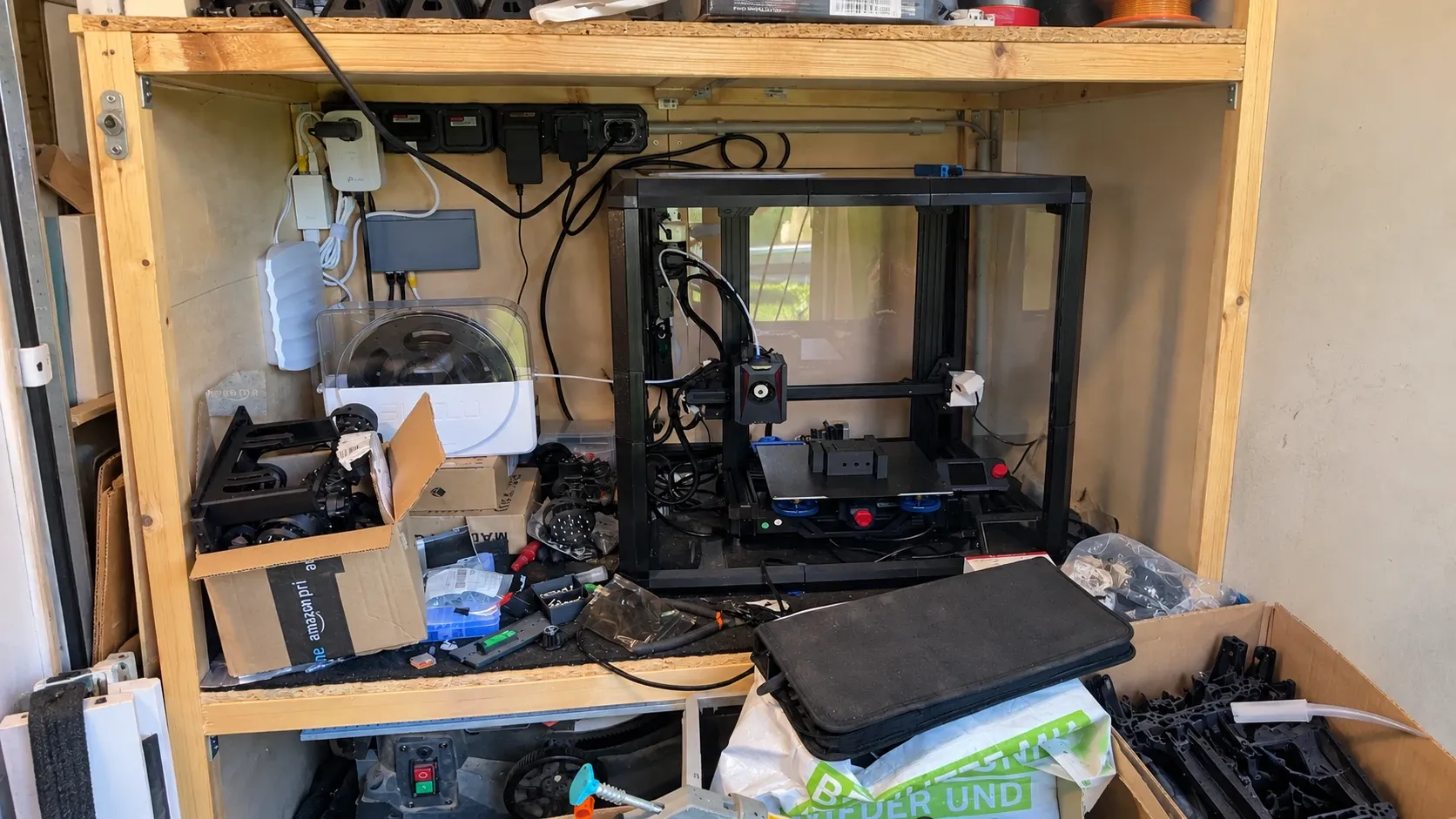
Then I reached the electronics. And suddenly the territory was familiar. Almost immediately the thoughts started: what if I do this differently? Replace this component? Redesign that part? Add something else? At some point, instead of the guy quietly assembling a car, the engineer appeared again, the one who absolutely has to improve something. I still enjoyed it. But the kind of enjoyment had changed.
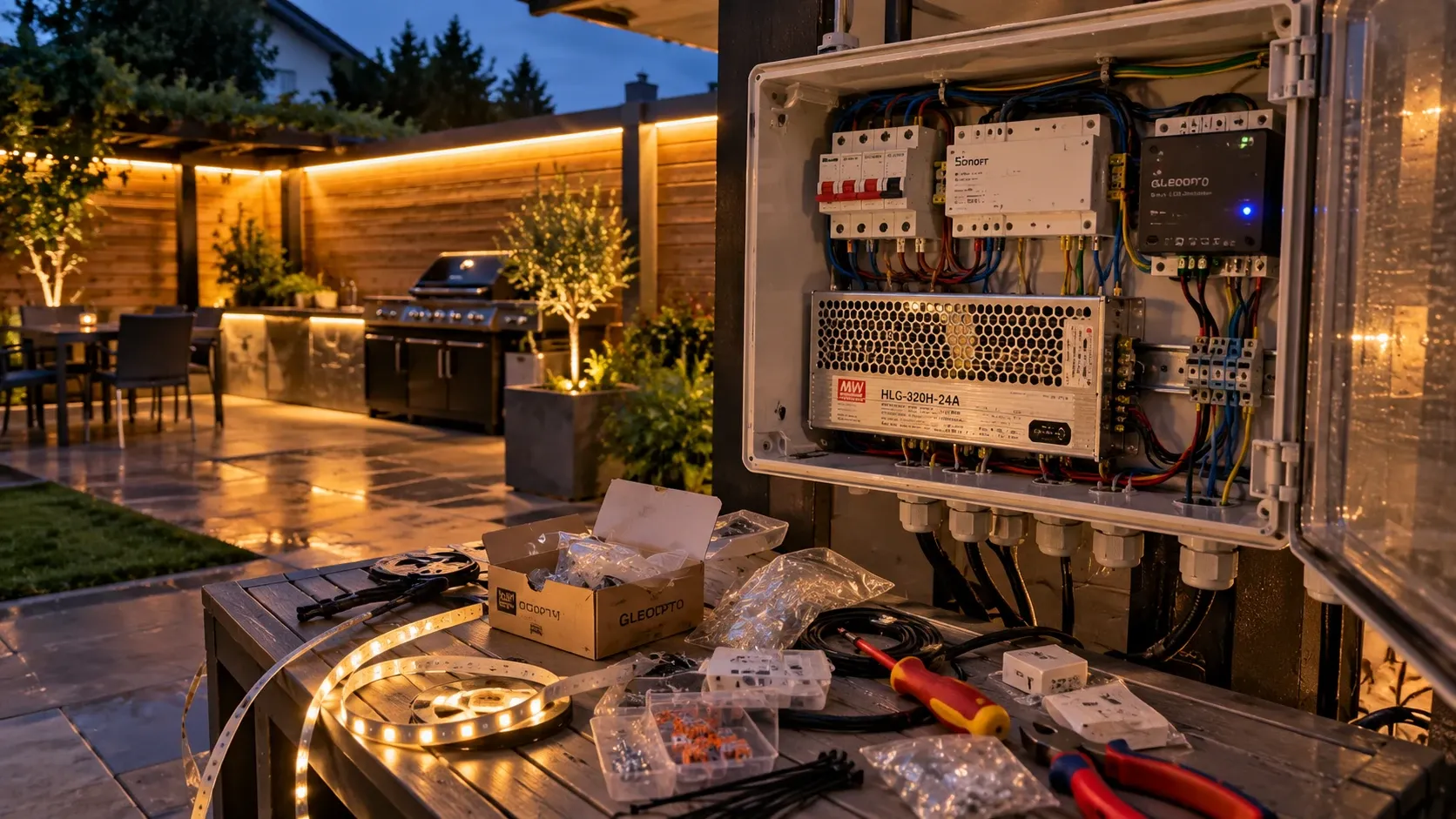
Later I started noticing the same pattern elsewhere. I wanted to add some lighting to the grill area. A very simple idea. I needed light: run a cable, mount it, switch it on. Then came controllers, automation, scenarios... And at some point, simple lighting had become a project again.
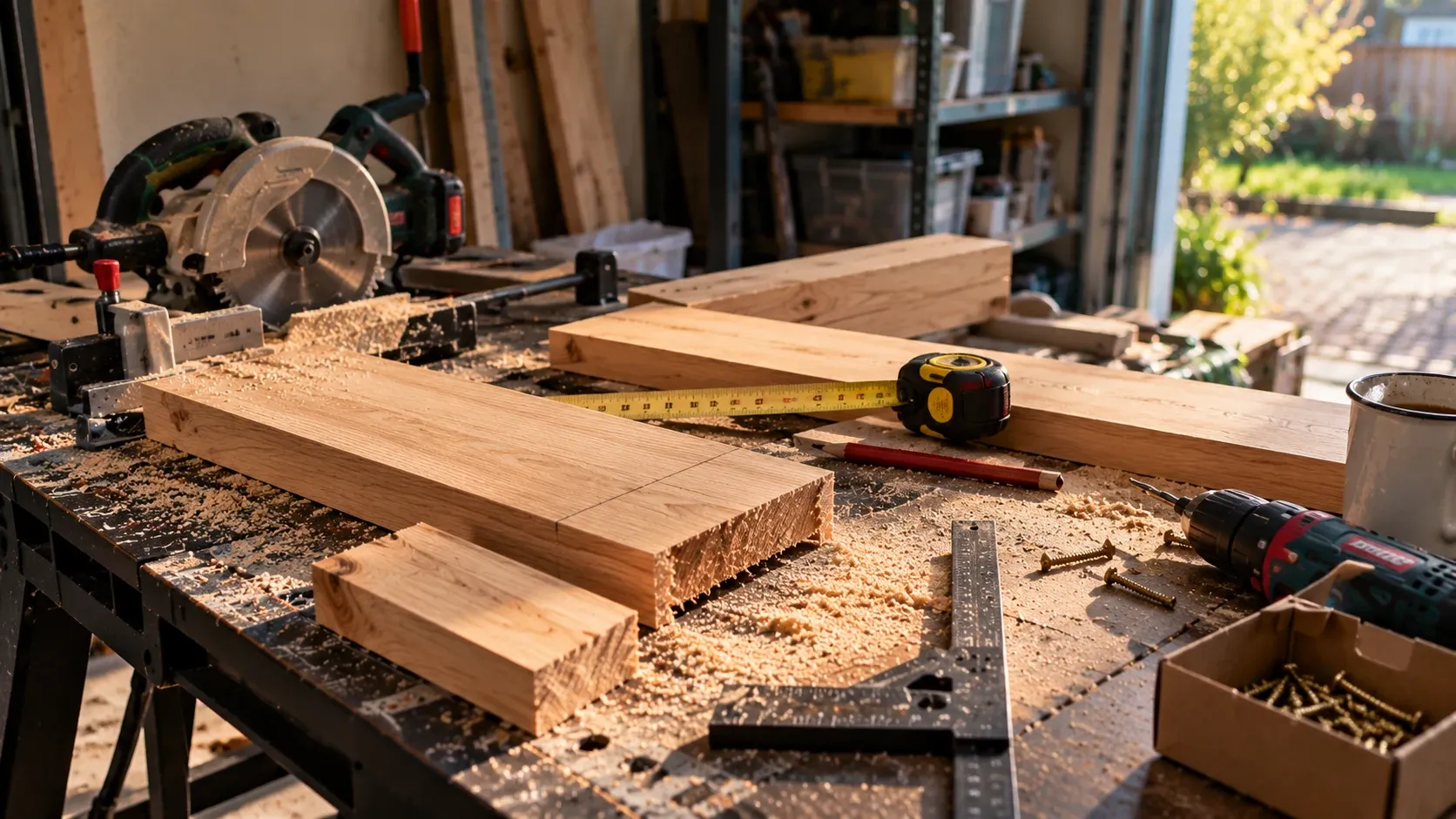
That is almost the opposite of what happens when I simply work with wood. I am absolutely not a carpenter. And maybe that's exactly why I enjoy it so much. I take a board, measure it, cut it, try it. Sometimes I realize I cut it wrong, take another one, measure again, screw things together.
There is almost nothing there that wants to become a system. I don't end up with twenty possible architectures for a shelf. The shelf just needs to hang. And somehow, that turns out to matter. Maybe some activities are so good at clearing my head precisely because I'm not an expert at them.
Whenever I get close to something I know well, a familiar mode switches on automatically. Improve. Optimize. Invent. But when I'm doing something where I'm a complete amateur, my brain works differently.
I think that's why, over time, I stopped thinking of rest as simply the absence of work. Because not working doesn't necessarily mean you're resting from work. You can lie on the sofa and keep working in your head. Sometimes, to genuinely stop thinking about one thing, you need to find something else that can take your attention. For some people that's the gym. For others it's cycling or gardening. For me, it changes.
But there is a trap here that I keep falling into myself. We engineers are remarkably good at turning almost anything into a project. Buy a bicycle? At first you just ride it. Then comes the app, statistics, kilometers, average speed, next month's target. Buy a 3D printer? At first you print funny things. A week later you're studying materials, profiles, temperatures, speeds, and wondering how to improve the quality by another five percent. Decide to install some lighting? A little later you have automation, then scenarios, and eventually you probably need monitoring for the monitoring.
And at some point you can discover that you don't have a hobby anymore. You have another project. Just without a salary or paid vacation, but with a backlog. I know this very well from myself. And I don't think it's necessarily bad. Some of my hobbies become interesting precisely because of this.
The problem only starts when I stop noticing the transition. When something that was supposed to clear my head starts loading it in exactly the same way again. When enjoyment starts being measured by the result. How well did it turn out? Did I finish it? Can it be better? Is there any practical value in it?
That's probably the point where it helps to stop sometimes. Not because improving things is bad, but because not everything has to be improved. Sometimes you can spend an evening on something completely pointless. Build something, discover that it doesn't work, take it apart again, and never return to it. From a productivity perspective, that's a completely wasted evening. Maybe that's exactly why it was a good one.
Not every bike ride has to improve your fitness. Not every home project has to be finished. Not every new interest has to become a skill. Not everything needs a next version. Sometimes it's enough that you were interested for a few hours. And that, for a few hours, you didn't think about work at all.
That's probably why I no longer see hobbies as another way to develop professionally. Sure, sometimes I learn something, and occasionally that knowledge turns out to be useful at work. But that's a side effect. The real value is somewhere else. A hobby gives life another axis. Something that exists independently of your profession, title, projects, and deadlines.
Travel gives me a similar feeling. You end up somewhere else, see something new, experience different things, and the usual stream of thoughts gets interrupted for a while. I think that's what I need from a good hobby: not to make me a better engineer, not to increase my productivity, not to prepare me for the next workday. Just to remind me that there is quite a lot of life outside work.
That said, I can't claim I've learned to separate these things perfectly. Quite the opposite. I still regularly turn hobbies into projects. I start improving, optimizing, imagining the next version. Sometimes I even build a mental backlog for something that was supposed to help me rest. Maybe that's simply part of an engineering mindset that never completely goes away. I'm not even sure I want it to.
I just want to notice the moment when something that helped me switch off starts becoming another job. And sometimes allow myself to stop earlier. Not improve it. Not automate it. Not invent the next version. Not turn everything into a result. Sometimes, just build the shelf. And leave it alone.